 Builders Merchants Journal – BMJ Publishing to Builders Merchants and the UK merchanting industry for more than 95 years
It is a tale told by an idiot, all sound and fury signifying nothing
Last night, I went to bed wondering if this is what it must have felt like to be alive during the Cuban Missile Crisis, that whisper in the head of “what happens if we wake up tomorrow and everything has changed?”
I’m too young to remember that, it was before I was born, but I did become a news-sentient being in the 1970s, growing up in the last decades of the Cold War. So, I remember watching Raymond Briggs’ devastating cartoon When the Wind Blows. At school, we watched Threads, the harrowing film about the aftermath of a nuclear attack on Sheffield, recorded by my sociology teacher on a scratchy-quality VHS cassette. There was Protect and Survive, the government information advising the public to prepare fallout rooms, use homemade shelters, and prepare for radiation. It was all very British: make do, carry on, and try not to think too hard about radiation sickness.
Back then, the fear was of a clear “other”: Russia, the big bad, the one that had stuck their missiles just 90 miles off the coast of Florida, like a chess-master placing his pieces strategically. The current tensions in the Middle East have had a very different tone. Less chess, more playground. More bluster, more of the sense that decisions are being made on the fly, without the sort of careful, measured thinking one might hope for when the stakes are, you know, civilisation.
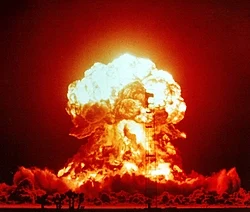
Some of what’s been said recently edges into territory that feels slightly off. Threats against civilian infrastructure, against entire populations, even hypothetically, are against the rules of decency and warfare. Theses are sorts of lines that, once crossed, are very difficult to redraw. Was it a nuclear threat? Some say yes, others insist absolutely not. But even the ambiguity is unsettling. The idea that there are weapons “we don’t want to use, but will if necessary” isn’t exactly comforting bedtime reading. Because if it ever does tip into that, then everything else becomes irrelevant.
And then, just like that, we wake up to news of a ceasefire, brokered by Pakistan, though Trump will probably claim it as all his doing. Iran reopening the Strait of Hormuz. Oil prices dropping back under $95 a barrel after briefly leaping over $100 for the first time in ages. One minute we’re staring into the abyss, the next we’re being told it’s all, if not fine, then at least “handled.” And you’re left wondering: what actually happened there? What started it? Was there a plan? Was there ever a plan?
Because from the outside, it’s hard not to feel like it was all a bit… improvised. There didn’t seem to be any sort of plan, or exit strategy, other than threaten, and threaten some more. I do wonder what his advisors were up to. Whether they were quietly saying, “If we do this, then this will likely happen.” Or whether they were sitting there, heads in hands as their counsel was ignored.
Somewhere along the line, somebody has done very well out of all this
One thing that does feel depressingly certain is that somewhere along the line, somebody has done very well out of all this. Whether by design or happy coincidence, there will be people who ended up richer, even though they probably didn’t need to. And the rest of us? We pay for it. At the petrol station, in our shopping bills, in the cost of moving goods from farms to supermarkets, from warehouses to doorsteps. The quiet, everyday economics of conflict. The kind that doesn’t make headlines but absolutely shapes lives.
We’re brought up here to believe that you stand up to bullies. Don’t back down, don’t give in, because bullies are cowards at heart and they will retreat if challenged. And sometimes that’s true. History has plenty of examples: World War II is the ultimate example of standing firm, and then we have later conflicts too, like the Gulf War, where intervention was justified as pushing back against aggression.
And when Vladimir Putin marched his troops into Ukraine, the response from the West was to support, to supply, to stand alongside, to open our homes, to provide military hardware and intelligence, if not actual personnel. Boris Johnson was particularly vocal about that, framing it very much in terms of resisting a bully before the behaviour spreads.
But what happens when the bully isn’t clearly “the other”? When the language, the threats, the tactics come from those who are supposed to be on your side?
For now, it seems the pattern is simple: a threat is made, and a ceasefire follows. But is that really how we want international relations to work in 2026? Is it just the way of things, that the louder, stronger, more unpredictable force gets its way? That one bully out-bullies another? And to be clear, Iran’s regime is no innocent party here. Not remotely. But ordinary Iranian civilians, just trying to live their lives? They’re the ones who end up caught in the crossfire, as ever. Always.
There’s also the question of what comes next. Remove one leader, and another steps in. Sometimes worse, sometimes more hardened, sometimes shaped entirely by what’s just happened. You have to wonder whether actions like this shut things down, or simply sow the seeds for the next generation of anger.
And that brings me back to my earlier question. What do you do when the bully is the one who’s supposed to be on your side?