 Builders Merchants Journal – BMJ Publishing to Builders Merchants and the UK merchanting industry for more than 95 years
Capitalism is the extraordinary belief that the nastiest of men for the nastiest of motives will somehow work for the benefit of all
It is – or it should be – a truth universally acknowledged that the yard-sale of government owned utilities has not been an unmitigated success. Far from it. I’ve written before about the uselessness of the various water companies, and this week, hopefully it will get a further public boost.
In 1989 the government transferred the assets and responsibilities of ten regional water authorities to private, publicly traded companies under the Water Act 1989 with a promise to the public they would become individual small shareholders or “H2Owners”. Local water owned by local people if you like.
But, as is inevitable, ‘public’ came to mean more than Mr and Mrs Bloggs and their £250 of shares. Public means anyone-and-anything-that-isn’t-the-government: hedge funds, pension companies, money broking corporations, investment banks, most of them owned overseas waded in. Yes, small individual investors may still own shares in some English water companies, but their ownership is now a very small fraction. The industry is now overwhelmingly dominated by overseas investment funds, pension funds, and private equity.
Two years ago, a TV programme aired that brought to the forefront a huge, mahoosive miscarriage of justice and scandal. It got the government to finally take notice, and it made a knight of a dogged determined former sub postmaster from north Wales. Mr Bates vs the Post Office was a dramatisation of a very real story, a story of lies, deceit and innocent people betrayed by systems they should have been protected by. It struck a chord and it worked.
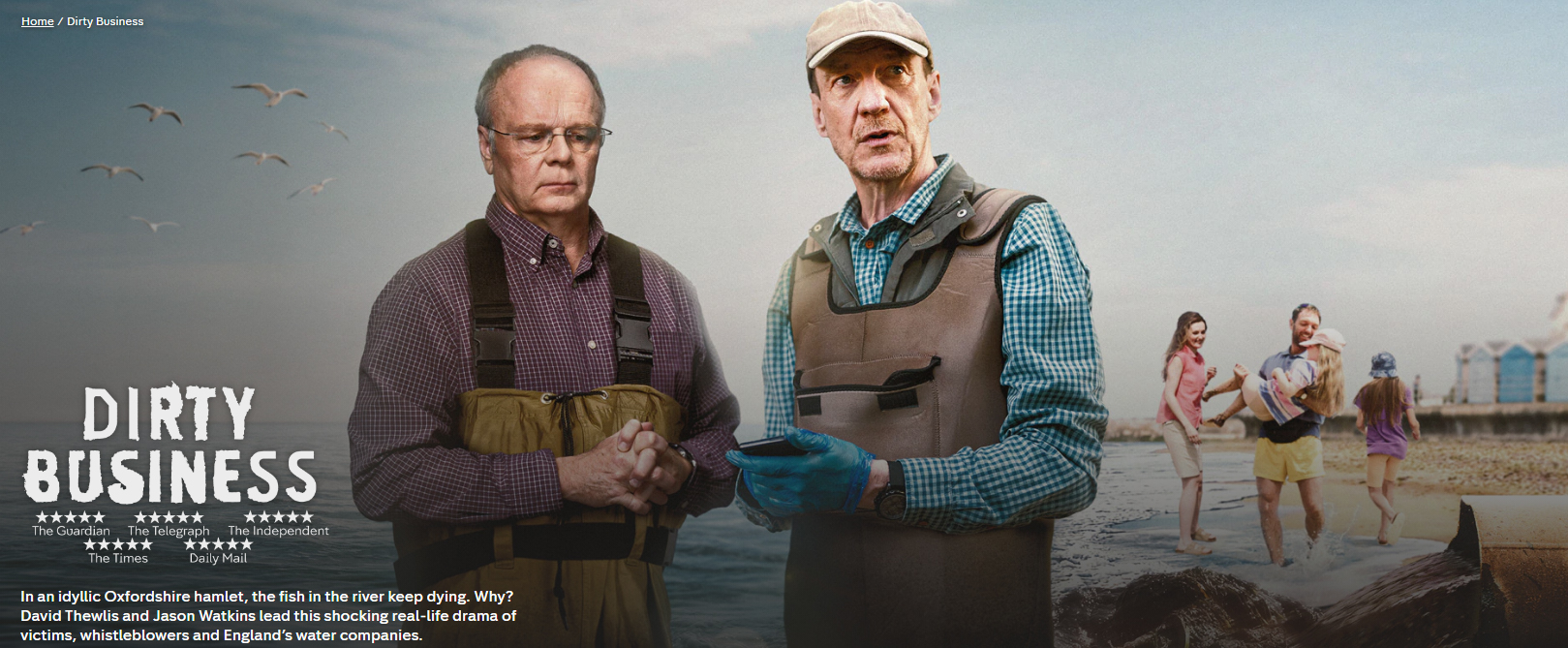
The producers, cast and writers of Dirty Business on Channel 4, are hoping that their programme will do the same thing for the scandalous disregard for the environment – and human health – exhibited by water companies and indeed the Environment Agency over the past 35 years. It should do.
The programme is horrifying.
Dirty Business is about the discharge of raw, untreated sewage into rivers and seas, specifically the River Windrush on Oxfordshire, and Dawlish Warren in Devon. It’s powerful. Really powerful. Gut-wrenchingly, stomach-churningly, horrifyingly powerful.
If you haven’t watched it yet, I strongly, strongly urge you to do so. Episode 1 aired on Monday night, episode 2 last night, and episode 3 is tonight. With every second that passed I found myself getting more and more angry. Angry at the scale of the incompetence, the deliberate under investment, the weaselling out of responsibility, all in the name of profit and backside covering.
Systematic underinvestment, a lack of repairs, ‘unpeopled’ treatment plants, which automatically send data from the filters and discharge units back to the central information point. Except when they stop working and no-one notices for days. Or months.
There is much talk about “operational self-monitoring” which moves the burden of identifying potential breaches of environmental law from the EA to… the water companies themselves. In effect, the water companies were supposed to dob themselves in, if they discovered they had done anything wrong. The scene where this news is broken to incredulous EA staff by a manager plays out like a Fast Show sketch about a boss telling workers of a manifestly ridiculous new company policy. It was all part of David Cameron’s ‘Bonfire of the Regulations” between 2011 and 2014 to reduce “over-zealous” rules in construction, health and safety, and the environment. There’s also a scene where the protagonists discover that a former second-in-command of at the EA, was moonlighting for water companies. The weaselling justification for this is quite something to watch.
The programme includes real footage, shot by campaigners to show the extent of the damage, is woven into the drama. The screens showing water full of excrement, sanitary products and loopaper floating around in the rivers and the beaches, the thousands of dead fish washed up at the riverbanks, those are all real, filmed by campaigners over the past 25 years.
The core of the programme is the ten-year investigation by Professor Peter Hammond, a data analysis computer whizz, and Ash Smith, a retired Met Police detective. But it’s interlaced with the tragic story of Heather Preen, an 8-year-old who went on holiday to Devon with her family and never came back. She caught E.coli 157 from an overflow pipe which was spilling raw sewage onto the beach at Dawlish Warren, a Blue Flag standard beach. In 1999. That’s 17 years before Smith and Hammond began their investigation into why their local river was completely brown (can you guess why, boys and girls?) The campaign group Surfers Against Sewage also features in the programme, and its website is well worth checking out.
Seventeen years wherein the once publicly run water industry was systematically asset-stripped, and, if Episode 1 of Dirty Business is anything to go by, left to rot, while the government agency that is supposed to check on the water companies’ compliance with the law washed its hands of the whole thing. The inquest into Heather’s death found the cause to be death by misadventure, while South West Water and the EA tried to blame dog faeces and gull droppings, even the fast food the family may have eaten whilst on holiday. That trip to the beach cost Heather her life, her parents, Mark and Julie, their marriage, and, ultimately Mark’s life.
Raw sewage discharge into our seas and rivers has continued apace since then. In 2024 alone water companies dumped raw sewage into England’s rivers and seas for 3.61m hours.
Over 70% of shares in English water companies are held by foreign investors; England and Wales, and Chile are the only countries in the world with a fully privatised, for-profit water and sewerage system. Other countries have some private investment, use public-private partnerships or contract out services, but retain public ownership of the infrastructure. There’s reason for that.
I have the space here to say everything I want to. To repeat myself, you need to watch Dirty Business and get angry. Very, very angry.