 Builders Merchants Journal – BMJ Publishing to Builders Merchants and the UK merchanting industry for more than 95 years
A traffic jam when you’re already late
A no-smoking sign on your cigarette break
It’s like ten thousand spoons when all you need is a knife
Oh, the irony. A few days before the final report from the inquiry into the Grenfell Tower fire is due to be published, another London tower block burns. And it catches fire whilst work is going on to remove the existing cladding from it. Flammable cladding.
A news release from the Fire Brigades Union quotes general secretary Matt Wrack thus: “Once again, a fire has erupted in a residential building wrapped in flammable cladding. There needs to be an urgent and swift investigation of how this has been allowed to happen.”
According to London Fire Commissioner Andy Roe, the building had a number of fire safety issues which the fire brigade knew about. “There will undoubtedly be concerns around the fire safety issues present within the building,” he said. Yeah, you think?
Just over eight years ago, we watched the news reports in horror as a tower block in one of the poorest parts of one of the wealthiest boroughs in one of the world’s wealthiest cities blazed.
The Grenfell Tower tragedy wasn’t down to just one thing. If it had been, the Inquiry would have been over long ago. Instead, it was a perfect storm of a number of causal factors all happening together. I’ve raved before about Pete Apps’ incredible book Show me The Bodies, which is something that every single person who has anything to do with making, selling, specifying or marketing any type of building materials should read and re-read. It makes clear that too many people made too many decisions that were wrong. Not just on the night in question, but in the months and years leading up to June 14 2017.
When the Inquiry closed nearly two years ago, it was clear from the lead counsel’s summing-up that the culture of buck-moving, obfuscation and blame-dodging was alive and well across pretty much all the parties involved in the refurbishment.
There was:
- Arconic: supplied the ACM cladding which was responsible for the fire’s rapid spread, and who knew that its fire rating wasn’t suitable for high-rise buildings under the tougher regulations in Europe
- Kingspan: its K15 insulation was used on a small part of the tower, but the composition had changed, making it unsuitable for use in residential buildings over 18m. nevertheless, it was used.
- Celtoex: the RS5000 boards was used for Grenfell after the tests were, to quite the Inquiry ‘over-engineered to achieve a pass’
- Kensington & Chelsea Tenant Management Organisation: took six years to attempt to fix a problem with the smoke system in the building, and under pressure from the council, looked for the lowest cost for the refurbishment of the Tower.
- Royal Borough of Kensington & Chelsea: the planning department put aesthetics as its priority, choosing the most dangerous form of the cladding
- Rydon: the contractors who worked with the tenant management organisation to reduce the costs of the project, cutting nearly half a million pounds by switching from metal cladding to cheaper combustible cladding
There’s more, as Apps’ book makes clear. The Fire Brigade is not without blame, for its insistence on the policy of stay-put and ait to be rescued. Had the TV screens in the incident room been working, operators would have seen what was happening and would have pushed the priority onto getting the people out.
A perfect storm. A perfect storm in which people died, and which the consequences are still being felt. And as the fire this week shows, the issues have not gone away.
Still, out of the Grenfell tragedy rose the CCPI, the Code for Construction Product Information. It grew out of Dame Judith Hackitt’s independent review of Building Regulations and Fire Safety, and works to ensure that construction product information is communicated in “a clear and accurate way”. So that everyone involved in making, selling, specifying or marketing any type of building materials knows exactly what those materials can and can’t be used for.
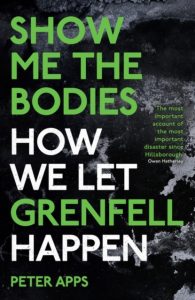
Seriously, if you haven’t already, then get this book and read it. If you have already, then read it again.