 Builders Merchants Journal – BMJ Publishing to Builders Merchants and the UK merchanting industry for more than 95 years
Forterra has partnered with LKAB Minerals to pioneer the repurposing of crushed brick waste to produce approximately 35,000 tonnes of calcined clay per year as a low-carbon alternative to traditional cement.
Derived from recycled brick waste, calcined clay can be used as a cement replacement, (Supplementary Cementitious Material) in accordance with the cement standards. SCM contributes to the concrete’s strength by increasing the strength-producing compounds and in doing so reducing the porosity of the concrete.
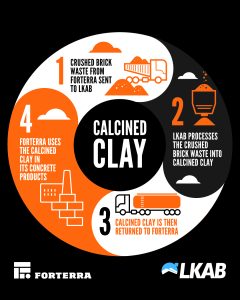
Conventionally, calcined clay is produced by heating raw clay at temperatures of between 700-800°C to drive off volatile compounds like water and carbon dioxide – a process called calcination. However, the combustion process is emissions heavy, resulting in high embodied carbon. Forterra’s approach avoids the high-temperature calcination process: the waste bricks have already been fired and the carbon accounted for. The embodied carbon of the final product is significantly reduced, and the entire process contributes towards a circular economy.
Brick waste from Forterra’s Kings Dyke factory is crushed and delivered to LKAB Minerals, who then fine-mill the waste to an agreed specification, processing it into a reactive calcined clay material. Initial use of the calcined clay at one of Forterra’s aggregate block plants in 2024 has resulted in a significant emissions avoidance of approximately 2,000 tonnes of CO2.
Forterra CEO Neil Ash, said: “We’re ambitious in our targets to reduce CO2 emissions within our operations and value chain, so being at the forefront of innovations such as this partnership shows the level of our aspirations, while also underpinning our commitment to the environment. Leading the way in sustainable and circular industry practices allows us to reduce our emissions and add value to our business. But it also has wider benefits. By offering high-quality, low-carbon products, we help to reduce the embodied carbon in construction, cutting emissions across the industry as a whole.”